NBA Injury Report Betting: Insider Medical Data Exploitation
 Available in US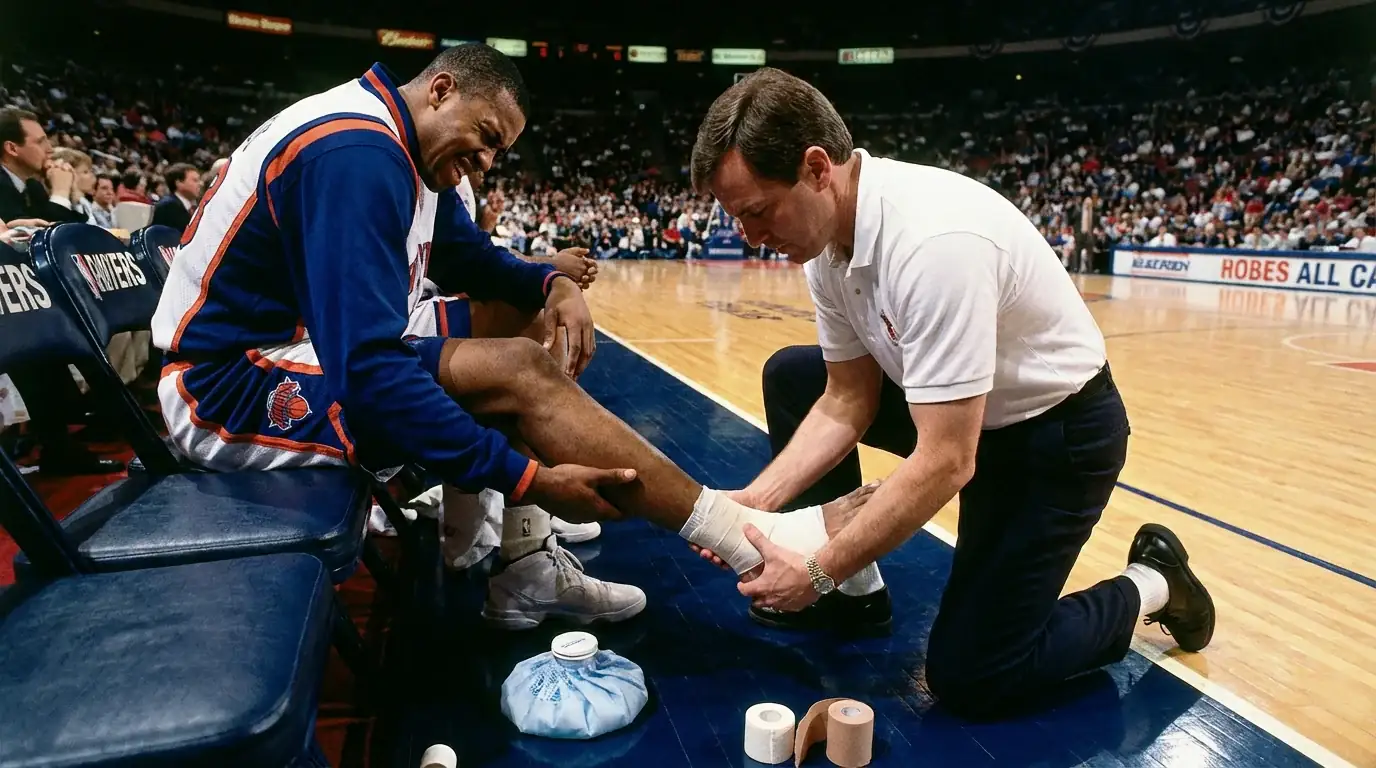
A former NBA team physician once told me something that stuck: “If the player says he can’t go in the first quarter, he doesn’t go. We can’t see pain. You can see swelling. You can see bruising. You can see a cut. But you can’t see pain.” That observation, shared by Dr. Tarek Souryal after decades with the Dallas Mavericks, captures the fundamental vulnerability that makes injury information so valuable to gamblers.
The NBA injury report exists to help bettors make informed decisions. Updated daily during the season, it categorises players as Out, Doubtful, Questionable, or Probable. Sportsbooks adjust their lines within minutes of report changes. A star player moving from Probable to Out might shift a spread by three or four points. For anyone who knows that status change before the public announcement, those minutes represent pure profit opportunity.
What transforms legitimate information into illegal advantage is timing. The player, his agent, the medical staff, the coaching staff, and team executives all know injury status before the official report. Anyone in that circle who shares that knowledge with bettors has created what amounts to insider trading in the sports betting market. The Jontay Porter scandal demonstrated exactly how this works in practice.
Impact of Medical Reports on Wagering Lines
I spent a week in 2022 tracking line movements immediately after NBA injury report updates. The patterns were striking. Major player announcements triggered instant adjustments across every licensed sportsbook, often within 90 seconds of publication. The speed demonstrated both market efficiency and the stakes involved.
Consider a hypothetical scenario. The Lakers play the Celtics tomorrow night, and the spread favours Los Angeles by 4.5 points. LeBron James is listed as Questionable with an ankle issue. If he is upgraded to Probable, the line might not move significantly – the market already priced in his likely participation. But if he is downgraded to Out, the spread might swing to Lakers -1.5 or even pick’em. That 3-point movement represents enormous betting value for anyone who knew the announcement was coming.
Sportsbooks understand this vulnerability. They employ sophisticated monitoring systems that flag unusual betting patterns before injury announcements. A sudden surge of money on one side of a spread, concentrated in the hour before a status change becomes public, triggers immediate investigation. These systems caught the suspicious betting around Jontay Porter’s early exits, eventually leading to his lifetime ban.
The challenge for regulators is that legitimate bettors sometimes anticipate injury updates based on public information – practice reports, player interviews, even social media activity. Distinguishing between informed analysis and actual inside information requires examining the specificity and timing of bets. Someone betting generally that a player might sit receives different scrutiny than someone placing large wagers precisely timed to a status change that has not yet been announced.
Medical Staff Vulnerability
Team physicians and athletic trainers occupy a peculiar position in the information chain. They possess the most accurate injury knowledge, updated continuously as they work with players, but they lack the financial incentives that might tempt players or coaches. Or so the league assumed for decades.
Dr. Souryal’s observation about invisible pain highlights a critical gap. Medical staff cannot definitively verify subjective symptoms. A player claiming migraine, nausea, or generalised soreness presents symptoms that cannot be objectively confirmed or denied. If that player has coordinated with bettors to exit a game early, the medical staff becomes unwitting accomplices to manipulation. They followed proper protocols, respected the player’s reported condition, and still facilitated fraud.
This vulnerability extends beyond deliberate manipulation. Medical staff discuss player conditions with colleagues, family members, and friends. A casual comment about a player’s lingering knee trouble, shared at a dinner party, might reach someone connected to gambling operations. The chain of information transmission can be remarkably short – a trainer mentions something to his brother, who mentions it at his weekly poker game, where someone recognises the betting opportunity.
The NBA has responded by tightening confidentiality requirements and expanding who falls under gambling policy restrictions. Medical staff now receive regular training on information security, with explicit warnings about the consequences of improper disclosure. Whether these measures prove sufficient remains to be seen. The incentives for exploitation persist as long as advance injury knowledge retains its betting value.
The Porter Manipulation Case
Jontay Porter played just three minutes against the Kings on 20 March 2025 before leaving with what he described as illness. That exit was not spontaneous. Associates had placed bets worth approximately $80,000 on prop bets tied to his underperformance, structured as parlays with potential payouts exceeding $1.1 million. The bets only made sense if someone knew Porter would barely play.
The mechanics were straightforward. Porter knew when he would leave the game. He communicated this to associates before tipoff. Those associates placed bets that would pay off only if Porter recorded minimal statistics. Porter then followed through, exiting with a reported illness that medical staff could not objectively disprove. The scheme collapsed only because sportsbooks flagged the suspicious betting patterns and reported them to league investigators.
What distinguished the Porter case from theoretical concerns was its documentation. Text messages, betting records, and financial transfers created a clear evidence trail. Porter’s subsequent guilty plea confirmed the scheme’s existence. His admission that he knew his conduct was wrong and unlawful closed any ambiguity about intent.
For integrity analysts like myself, the Porter case validated years of warnings about prop bet vulnerability. We had long argued that individual performance markets created manipulation opportunities that traditional game-outcome bets did not. A player cannot easily throw an entire game without his teammates noticing and compensating. But he can absolutely control his own early exit from a game, his own rebound attempts, his own shot selection. Porter proved these theoretical vulnerabilities were practical realities.
NBA Policy Changes
Commissioner Adam Silver acknowledged after the Porter ban that the case raised important questions about the regulatory framework for sports betting, including the types of bets offered on games and players. That statement signalled policy changes were coming, and they have begun arriving.
The league has pushed sportsbooks to limit certain player prop markets, particularly those tied to statistics that individual players can easily manipulate. Under-bets on rebounds, assists, and minutes played – exactly the markets Porter exploited – now face enhanced monitoring and lower betting limits at many books. Some operators have withdrawn these markets entirely for players on two-way contracts or those outside regular rotation.
Injury reporting requirements have also tightened. The window between internal status decisions and public announcements has shrunk, reducing the time advantage for anyone with inside information. Teams now face scrutiny if their injury report updates correlate suspiciously with betting activity, creating institutional incentives to prevent leaks.
These changes acknowledge that sports betting and sports integrity exist in tension. The leagues benefit financially from betting partnerships – the advertising revenue, the enhanced fan engagement, the data licensing fees. But those benefits depend on public confidence that games are fairly contested. Every manipulation scandal erodes that confidence. The NBA’s policy evolution reflects an organisation trying to preserve betting revenue while minimising integrity risks, a balance that requires constant adjustment.
How do injury reports affect NBA betting odds?
NBA injury reports directly influence betting lines. When a significant player is ruled out, spreads can shift by 3-5 points depending on the player’s importance. Sportsbooks adjust lines within minutes of official updates. This immediate market response creates potential value for anyone who knows injury status before public announcement, which is why insider trading of injury information has become a federal concern.
What penalties exist for leaking injury information?
Leaking confidential injury information to gamblers can result in lifetime bans for players and staff, as demonstrated by the Jontay Porter case. Beyond league discipline, federal wire fraud charges apply when electronic communications are used to transmit inside information that facilitates betting schemes. Maximum federal sentences reach 20 years, though actual sentences depend on the scope and nature of the violation.
Published by the nba Player Betting on Games team.